tripma
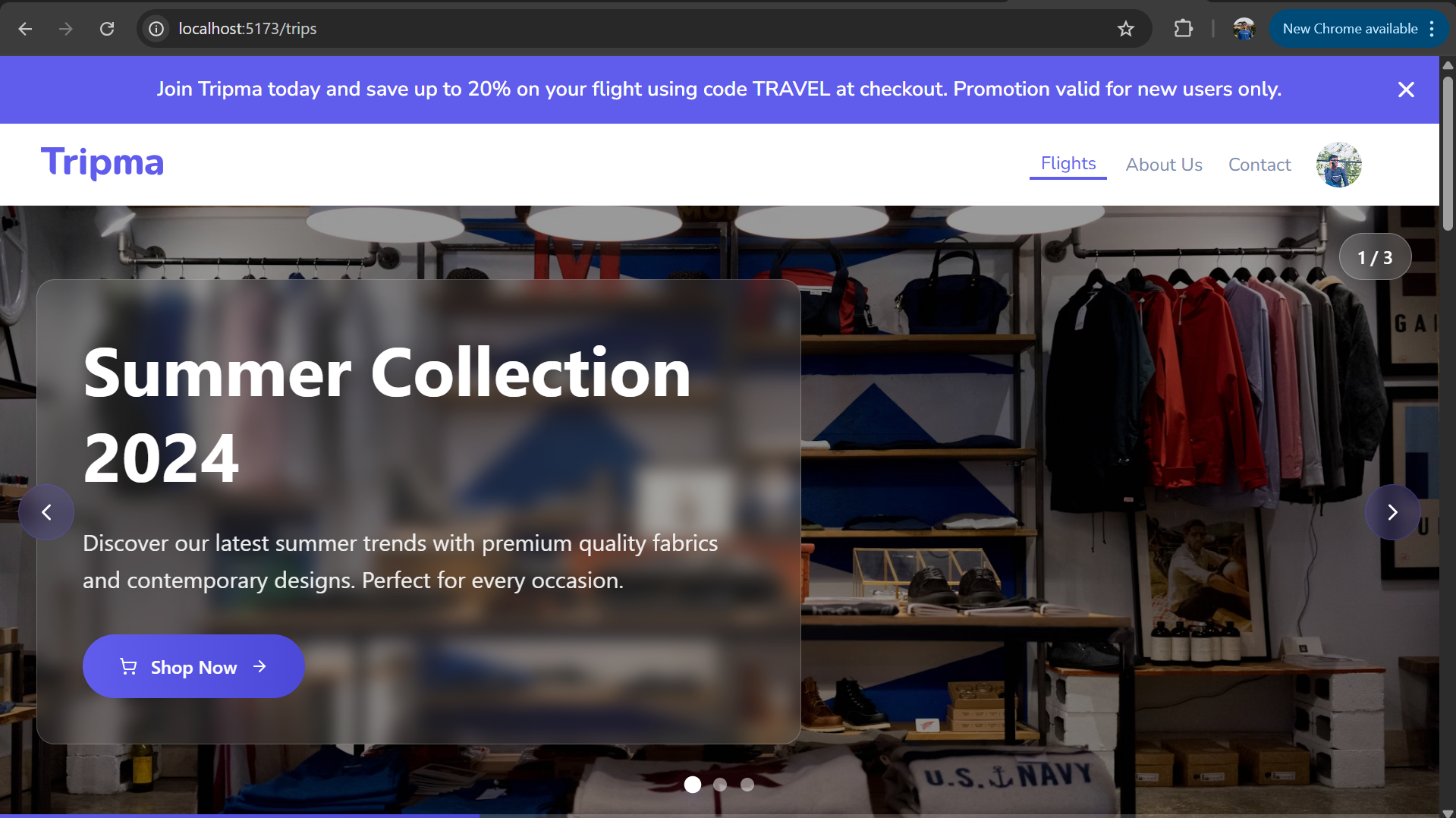
A comprehensive flight and travel booking platform that enables users to search and reserve flights, plan multi-destination trips, explore travel destinations, and manage bookings through a seamless and modern travel experience.
Table of Contents
Tripma – Flight & Trip Booking Platform
Introduction
Modern travel planning is typically fragmented across multiple services—flight aggregators, hotel booking platforms, and separate itinerary planners. This fragmentation creates inefficiencies in both user experience and data management.
Tripma was designed as a unified travel booking platform that combines flight search, booking management, destination exploration, and user profiling into a single system. Beyond the user experience, the project focuses heavily on backend scalability, clean API design, and structured data modeling for travel-related entities such as flights, airports, trips, and bookings.
The system follows a full stack architecture with a clear separation between frontend, backend, and database layers, enabling maintainability and extensibility.
Flight Search and Booking Architecture
The flight booking module is the core of Tripma and is designed around a structured search and booking workflow.
Users can search flights using origin and destination airport codes, select one-way or round-trip journeys, and define departure and return dates. Passenger configuration supports adults and minors, and pricing is dynamically calculated based on travel class (economy, business, first class).
From a technical perspective, the flight search flow is designed as a REST-driven query system. The frontend sends structured search parameters to the backend, which processes filtering logic and returns available flight options along with pricing and seat availability data.
Seat selection is modeled using structured seat maps, allowing the system to track availability per cabin class. This ensures consistency between booking state and backend data, preventing double booking scenarios.
Trip Planning and Destination System
Tripma extends beyond traditional flight booking by introducing a trip and destination layer.
Destinations are modeled as independent entities linked to flights and trips. Each destination contains metadata such as tags, descriptions, and media references. This allows the system to support both functional booking flows and exploratory travel discovery.
From a data modeling perspective, this introduces a relational structure between flights, trips, and places, enabling multi-destination itineraries to be built as composite objects stored in the database.
User System and Authentication
The user system is designed to support both authentication and enriched user profiles.
Authentication is handled using a token-based approach with JWT, ensuring stateless session management across the frontend and backend. In addition to standard login flows, OAuth integration is supported through Google, Apple, and Facebook, enabling third party authentication without storing sensitive credentials directly.
User profiles are structured to include identity information such as name, date of birth, contact details, and address. Additional fields such as emergency contacts and known traveler IDs are included to support real world travel use cases.
The system also models user relationships, allowing for future expansion into social travel features.
Booking and Transaction Model
The booking system supports both direct flight reservations and multi destination trip bookings.
Each booking record is structured to include passenger-level details such as seat assignment, baggage count, travel class, pricing breakdowns, taxes, and discount applications. This ensures that every booking is fully traceable and reproducible from stored data.
The system is designed with transactional consistency in mind, ensuring that seat allocation and booking confirmation are handled atomically to prevent conflicts in high concurrency scenarios.
Feedback and ratings are also tied to completed trips, enabling a feedback loop that can be used for future recommendation systems.
Backend Architecture
The backend is built using Node.js with Express.js, following a RESTful API architecture.
Express is used to define modular route handlers for key domains such as flights, bookings, users, and destinations. This separation allows each domain to evolve independently while maintaining a consistent API structure.
Middleware is heavily used for authentication (JWT verification), request validation, and error handling. This ensures that business logic remains cleanly separated from request processing logic.
The backend is designed to be stateless, making it suitable for horizontal scaling in cloud environments.
Database Design
MongoDB is used as the primary database, with Mongoose acting as the ODM layer.
The schema design is document oriented and optimized for flexible travel data representation. Key models include:
* Flights, Aircraft, Airports for flight operations
* Users, UserAccount, UserRelation for identity management
* DirectBooking and TripBooking for reservation handling
* Place, FeaturedPlace, Tag, Trip for destination and itinerary modeling
* UserFeedback and UserTrip for analytics and engagement tracking
This schema structure allows for both transactional data (bookings) and relational-like associations (trips and destinations) within a NoSQL environment.
Frontend Architecture
The frontend is built using React.js with TailwindCSS for styling and Framer Motion for animations.
React is used to build a component-driven architecture where features such as flight search, booking forms, seat maps, and trip planners are isolated into reusable components. This improves maintainability and scalability of the UI layer.
TailwindCSS enables utility-first styling, allowing rapid UI development without maintaining large CSS files. This is particularly useful for building responsive layouts for complex interfaces like flight filters and seat selection grids.
Framer Motion is used to enhance user experience through smooth transitions, page animations, and interactive feedback during booking flows.
API communication is handled using Axios, ensuring a clean abstraction layer between frontend components and backend services.
System Scalability and Design Considerations
The system is designed with scalability in mind across all layers.
On the backend, stateless authentication and modular routing allow for horizontal scaling. On the frontend, component-based architecture ensures that UI complexity remains manageable as features grow. On the database side, MongoDB schema flexibility supports evolving travel data structures without major migrations.
The architecture also allows for future integration of external services such as real-time flight APIs, payment gateways, and notification systems.
Future Improvements
Several enhancements are planned to further evolve the system:
* Interactive seat selection with real-time synchronization
* Payment gateway integration (Stripe or PayPal)
* Admin dashboard for managing flights and destinations
* Real-time flight status updates and notifications
* Multi-language support for global accessibility
Conclusion
Tripma demonstrates how a modern travel platform can be engineered using a full stack JavaScript ecosystem. By combining React, Node.js, Express, and MongoDB, the system achieves a balance between performance, scalability, and developer productivity.
More importantly, the project highlights how proper system design—especially around flight search logic, booking consistency, and modular API architecture—can transform a complex travel domain into a structured and maintainable software system.