User Management System
A full stack user management system that streamlines employee, department, EPF, and administrative data management through a centralized dashboard with real time analytics and structured organizational control.
Table of Contents
User Management System
Introduction
Managing organizational data such as employees, departments, payroll-related contributions, and administrative records is often complex when handled through disconnected tools or manual processes. It leads to inconsistencies, duplication of data, and a lack of real-time visibility into organizational structure and workforce analytics.
The User Management System was designed to centralize and streamline these operations into a single web-based platform. It provides a structured environment where organizations can manage employees, departments, EPF configurations, and administrative operations efficiently while maintaining data consistency and security.
The system follows a modern full stack architecture using React on the frontend, Express.js on the backend, and MongoDB as the database layer, ensuring scalability and modular development.
Employee Management System
The employee module forms the core of the system and handles complete employee lifecycle management.
It supports full CRUD operations for employee records, including personal information, employment details, and family-related data. Each employee profile contains structured fields such as name, address, date of birth, NIC, gender, and email, ensuring standardized data storage.
Employment-related details such as EPF number, department assignment, join date, salary information, and employment type are also maintained within the system. This allows organizations to maintain a complete and structured employee registry.
Additionally, the system supports extended employee data such as marital status, spouse details, children, and guardianship information. Profile images and contact information further enhance employee record completeness.
By consolidating all employee-related data into a single system, it reduces fragmentation and improves data accessibility across departments.
Department Management
The department module enables organizations to define and manage internal structural units.
Each department contains basic metadata such as name and description, allowing organizations to categorize employees based on functional roles or operational units.
This structure enables better workforce organization, reporting segmentation, and hierarchical clarity within the system.
EPF Management System
The EPF module is responsible for managing Employee Provident Fund configurations and related financial rules.
It allows administrators to define EPF settings and associate them with employee records. This ensures consistency in contribution tracking and supports organizational compliance requirements.
By digitizing EPF management, the system reduces manual calculation errors and improves transparency in financial structuring.
Admin Management and Security
The system includes a dedicated admin module that handles secure authentication and administrative control.
Administrators are responsible for managing system-level configurations, overseeing employee data, and maintaining overall platform integrity. Secure login mechanisms ensure that only authorized users can access sensitive administrative functions.
This separation of roles enhances security and ensures controlled access to critical operations.
Dashboard and Analytics
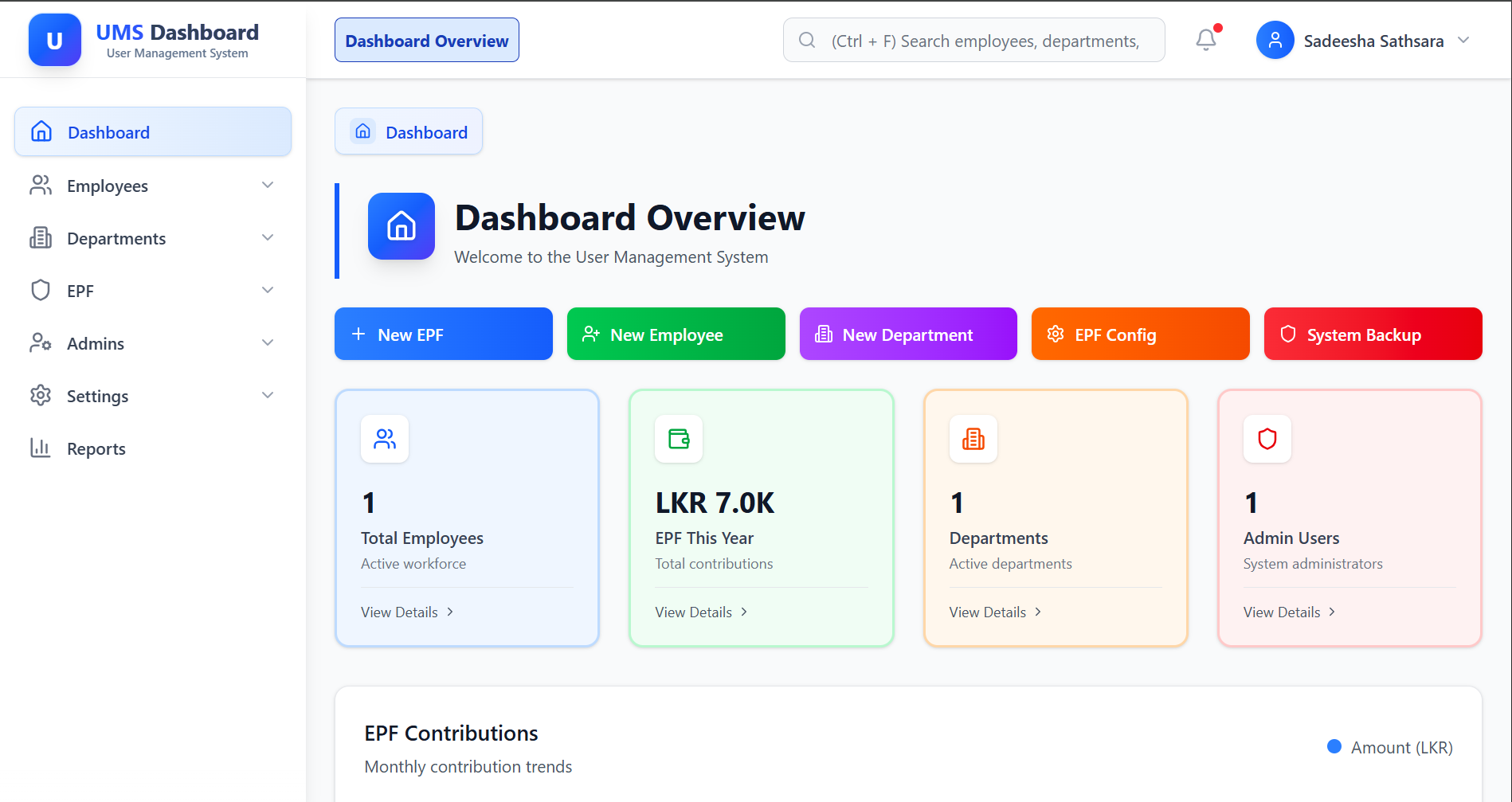
The dashboard serves as the central intelligence layer of the system, providing real-time insights into employees, departments, EPF data, and administrative activity.
It displays aggregated statistics that help organizations understand workforce distribution and system usage at a glance. These insights support decision-making and operational planning by providing structured visibility into organizational data.
Reporting System
The reporting module enables the generation of structured organizational reports.
These reports provide insights into employee distribution, departmental breakdowns, and EPF-related summaries. This helps organizations maintain compliance, track internal metrics, and support audits or management reviews.
System Architecture
The system is built using a modern full stack architecture designed for scalability and maintainability.
The frontend is developed using React, enabling a component-based architecture that improves reusability and user experience. The use of Vite ensures fast development builds and optimized performance.
The backend is implemented using Express.js, which handles API requests, business logic, authentication, and database communication. It follows a modular structure that separates concerns and improves maintainability.
MongoDB is used as the database layer, providing a flexible document-based structure for storing employee records, departments, EPF data, and administrative information. Mongoose is used to enforce schema structure and maintain data consistency.
User Experience and Interface Design
The interface is designed to be clean, responsive, and intuitive for administrative users.
Navigation between modules such as employees, departments, EPF, and reports is streamlined to reduce complexity. The dashboard-first design ensures that users can quickly access key metrics and system insights without navigating through multiple layers.
Development Approach
The project follows a modular development approach with clear separation between frontend and backend responsibilities.
Code quality is maintained through linting tools and structured project organization. This ensures maintainability and makes it easier to extend system features in the future.
Conclusion
The User Management System demonstrates how a centralized digital platform can simplify organizational data management by integrating employee records, departmental structure, EPF configuration, and administrative control into a single system.
By combining structured data modeling with a scalable full stack architecture, the system improves efficiency, reduces manual workload, and enhances overall organizational transparency.