Building Async CV Microservices with RabbitMQ & OpenCV
An in-depth look at bridging Node.js APIs and Python OpenCV models asynchronously. Learn how to prevent blocking CPU cycles and scale facial recognition systems.
Table of Contents
Building Async CV Microservices with RabbitMQ & OpenCV
An in-depth look at bridging Node.js APIs and Python OpenCV models asynchronously, and why "just calling Python from Node" quietly destroys your throughput.
Why This Matters
Computer vision features (face matching, object detection, OCR) almost always get bolted onto an existing Node.js backend because that's where the rest of the API already lives. The natural instinct is to wire OpenCV (or any heavy model) directly into the same process that's handling HTTP traffic.
That instinct is wrong, and understanding why it's wrong is the key to designing a system that scales. This post walks through the failure mode, the fix, and the reasoning behind every architectural decision, not just the code.
Decoding Image Processing Blockages
Node.js Is Built for I/O, Not Math
Node's entire performance story is built around a single-threaded event loop. It's extremely good at one thing: juggling thousands of concurrent I/O operations (HTTP requests, database queries, file reads) by never sitting around waiting for any of them. While a request is waiting on the network or disk, Node hands control back to the event loop so it can serve someone else.
That trick only works because I/O operations are handed off to the OS or to libuv's thread pool. The main JavaScript thread itself stays free.
CPU-bound work breaks this model completely. Matrix multiplication, color space conversion, Haar cascade classification are pure computation. There's no "waiting" to hand off. The JavaScript thread has to grind through every cycle itself, and until it finishes, nothing else runs. Not your health check endpoint, not your auth middleware, not the next user's request.
The Problem in Practice
Picture an API gateway that accepts image uploads and uses an inline binding (something like opencv-express) to run inference directly inside the request handler:
Client → POST /detect-face → [Node.js runs OpenCV synchronously] → ResponseThe moment that handler starts running cv2 style operations:
A handful of test requests will look fine. The moment 20 users upload photos within the same second, your API effectively becomes single-request-at-a-time, no matter how many users Node was theoretically designed to handle.
Why Not Just Use Worker Threads or Clustering?
It's a fair question. Node does offer worker_threads and cluster for spreading CPU work across cores. But for computer vision specifically, this isn't the right tool:
opencv-python.What you actually want is to remove vision processing from the API process entirely, not just from the main thread, but from the same service altogether.
Decoupling OpenCV into a Python Sidecar
The fix is a classic distributed systems move: split the system by responsibility, not by convenience. Node does what Node is good at (accepting and routing requests). Python does what Python is good at (running OpenCV).
The two halves don't call each other directly. They communicate through a message broker, RabbitMQ, which acts as a buffer, a load balancer, and a decoupling layer all at once.
The Two Services
1. API Gateway (Node.js)
Accepts binary image uploads over HTTP, saves them temporarily to disk (or object storage), and publishes a lightweight job, just metadata like a file path and a job ID, onto a RabbitMQ task queue. It does not touch the image data computationally. It then waits for a reply, without blocking the event loop, using RabbitMQ's request/reply pattern.
2. Vision Worker (Python + OpenCV)
One or more independent processes, each consuming jobs off the queue. Each worker reads the image from disk, runs the actual face detection/matching logic, and publishes the result back to a reply queue that only the original requester is listening to.
This is the RPC over message queue pattern: you get the synchronous feel of a request/response API, but the heavy lifting happens in a completely separate, horizontally scalable pool of workers.
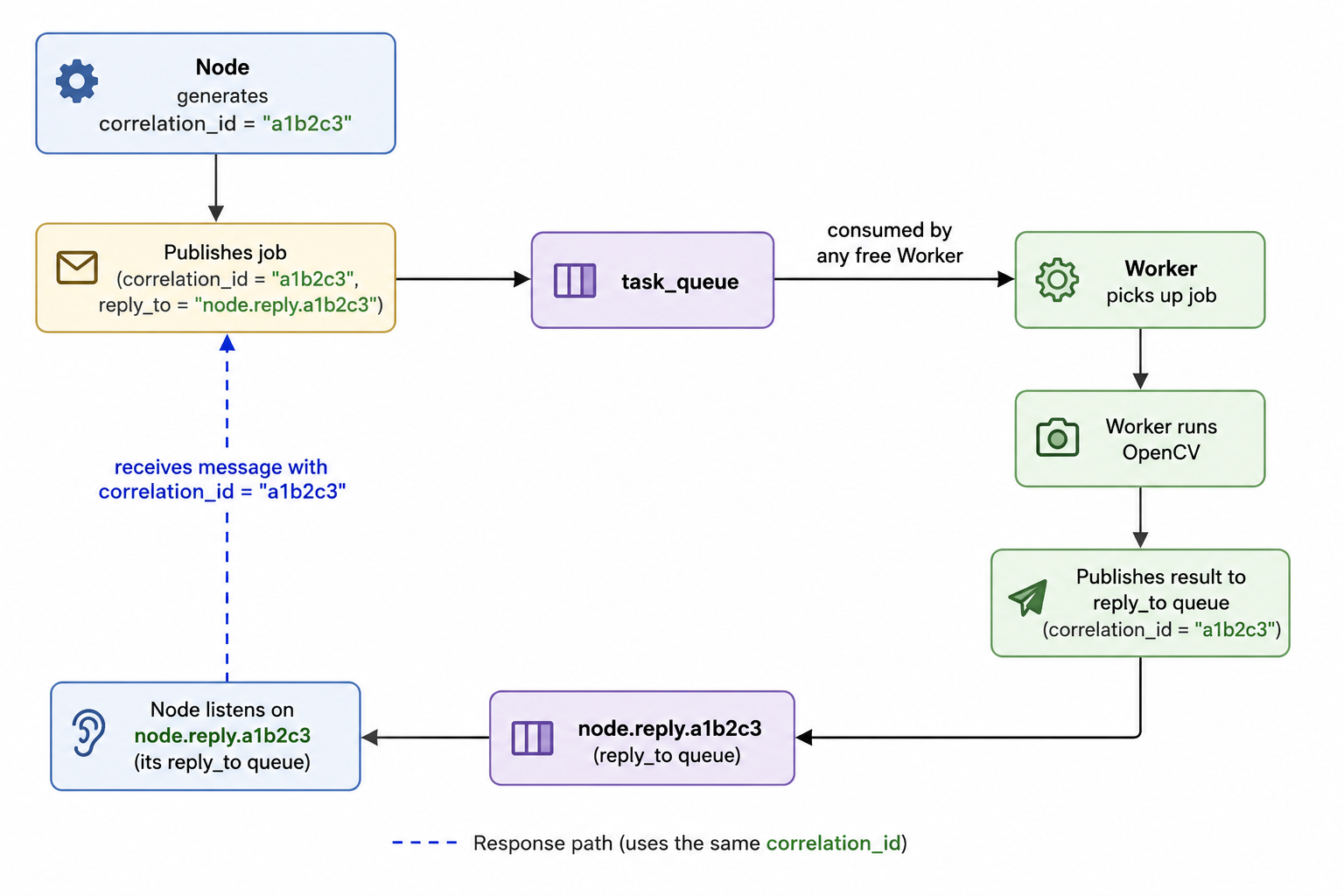
How the Messages Find Their Way Back
This is the part that trips people up the first time: if many requests are in flight, how does Node know which reply belongs to which original request?
RabbitMQ's RPC pattern solves this with two pieces of metadata attached to every message:
The Python Worker
# Python Worker consuming image frames
import cv2
import pika
import json

face_cascade = cv2.CascadeClassifier(
    cv2.data.haarcascades + 'haarcascade_frontalface_default.xml'
)

def on_request(ch, method, props, body):
    data = json.loads(body)
    image_path = data['path']

    # Process matrix operations
    img = cv2.imread(image_path)
    gray = cv2.cvtColor(img, cv2.COLOR_BGR2GRAY)
    faces = face_cascade.detectMultiScale(gray, 1.1, 4)

    response = {'faces_detected': len(faces)}

    ch.basic_publish(
        exchange='',
        routing_key=props.reply_to,
        properties=pika.BasicProperties(correlation_id=props.correlation_id),
        body=json.dumps(response)
    )
    ch.basic_ack(delivery_tag=method.delivery_tag)

connection = pika.BlockingConnection(pika.ConnectionParameters('localhost'))
channel = connection.channel()
channel.queue_declare(queue='vision_tasks')

# Only pull one job at a time per worker, don't hoard messages
channel.basic_qos(prefetch_count=1)
channel.basic_consume(queue='vision_tasks', on_message_callback=on_request)

print("Vision worker waiting for jobs...")
channel.start_consuming()
A few details worth calling out:
The Node.js Side (the part most write ups skip)
The Python worker is only half the story. The Node gateway has to publish the job and await the matching reply without blocking. Here's the shape of that:
// Node.js API Gateway: RPC client over RabbitMQ
const amqp = require('amqplib');
const { v4: uuidv4 } = require('uuid');

async function detectFaces(imagePath) {
  const connection = await amqp.connect('amqp://localhost');
  const channel = await connection.createChannel();

  const { queue: replyQueue } = await channel.assertQueue('', { exclusive: true });
  const correlationId = uuidv4();

  return new Promise((resolve, reject) => {
    channel.consume(replyQueue, (msg) => {
      if (msg.properties.correlationId === correlationId) {
        resolve(JSON.parse(msg.content.toString()));
        channel.close();
        connection.close();
      }
    }, { noAck: true });

    channel.sendToQueue(
      'vision_tasks',
      Buffer.from(JSON.stringify({ path: imagePath })),
      { correlationId, replyTo: replyQueue }
    );
  });
}

// Used inside an Express route, no blocking, no frozen event loop
app.post('/detect-face', upload.single('image'), async (req, res) => {
  const result = await detectFaces(req.file.path);
  res.json(result);
});
Notice what's not happening here: there's no cv2 import, no native bindings, no CPU-bound loop anywhere in this file. Node is purely orchestrating: sending a message, awaiting a promise, returning JSON. The event loop never stalls, because none of this work is synchronous CPU work; it's all I/O (network calls to RabbitMQ), which is exactly what Node is designed for.
Why This Scales
With this structure, the two halves of the system scale independently:
Practical Considerations Before You Ship This
A few things worth thinking through before this pattern goes to production:
1. Timeouts on the Node side. Always wrap the RPC call in a timeout. If a worker dies without acking or nacking, a request can hang forever waiting for a reply that's never coming.
2. Disk vs. object storage. Saving images to local disk only works cleanly if Node and the Python workers share the same filesystem (e.g., same host, or a shared volume in Kubernetes). In a multi host setup, push uploads to S3/object storage instead and pass a URL, not a local path.
3. Idempotency. Because RabbitMQ can redeliver a message after a crash, the same image might get processed twice. If "process this image" has side effects (e.g., writing to a database), make sure it's safe to run twice.
4. Monitoring queue depth. A growing vision_tasks queue is your earliest warning sign that workers can't keep up. Track it before users start noticing slow responses.
5. Cleanup. Temporary files written to disk by the API gateway need a TTL or cleanup job, or you'll slowly fill the disk with processed uploads nobody needs anymore.
The Core Lesson
The underlying principle generalizes well beyond face detection: whenever a request handler has to do real CPU work, it doesn't belong in the same process that's accepting traffic. A message queue isn't just plumbing between two languages. It's what lets you scale the "thinking" part of your system completely independently from the "talking to clients" part.
Node.js and Python aren't competing here. Node is the front door. Python and OpenCV are the workshop in the back. RabbitMQ is the hallway that keeps the two from blocking each other.