How Money Really Flows Through a Business
Learn how money really flows through a business using a simple coffee shop example. Understand revenue, expenses, profit, cash flow, assets, and liabilities in plain language, no accounting jargon required.
Table of Contents
Why Understanding Money Flow Matters More Than Learning Accounting
Most people think finance is boring, full of spreadsheets, jargon, and rules meant only for accountants. But there is a simpler way to look at it. Instead of memorizing accounting terms, you can learn to understand how money actually moves through a company. Once that clicks, you start to see businesses the way engineers see systems: inputs, processes, and outputs.
This shift in thinking is especially valuable if you ever want to build AI systems or software solutions for businesses. You cannot design something that truly helps a company unless you understand where its money comes from, where it goes, and where it gets stuck along the way. So let us build that understanding from the ground up, using something everyone can picture clearly: a coffee shop.
Imagine You Own a Coffee Shop
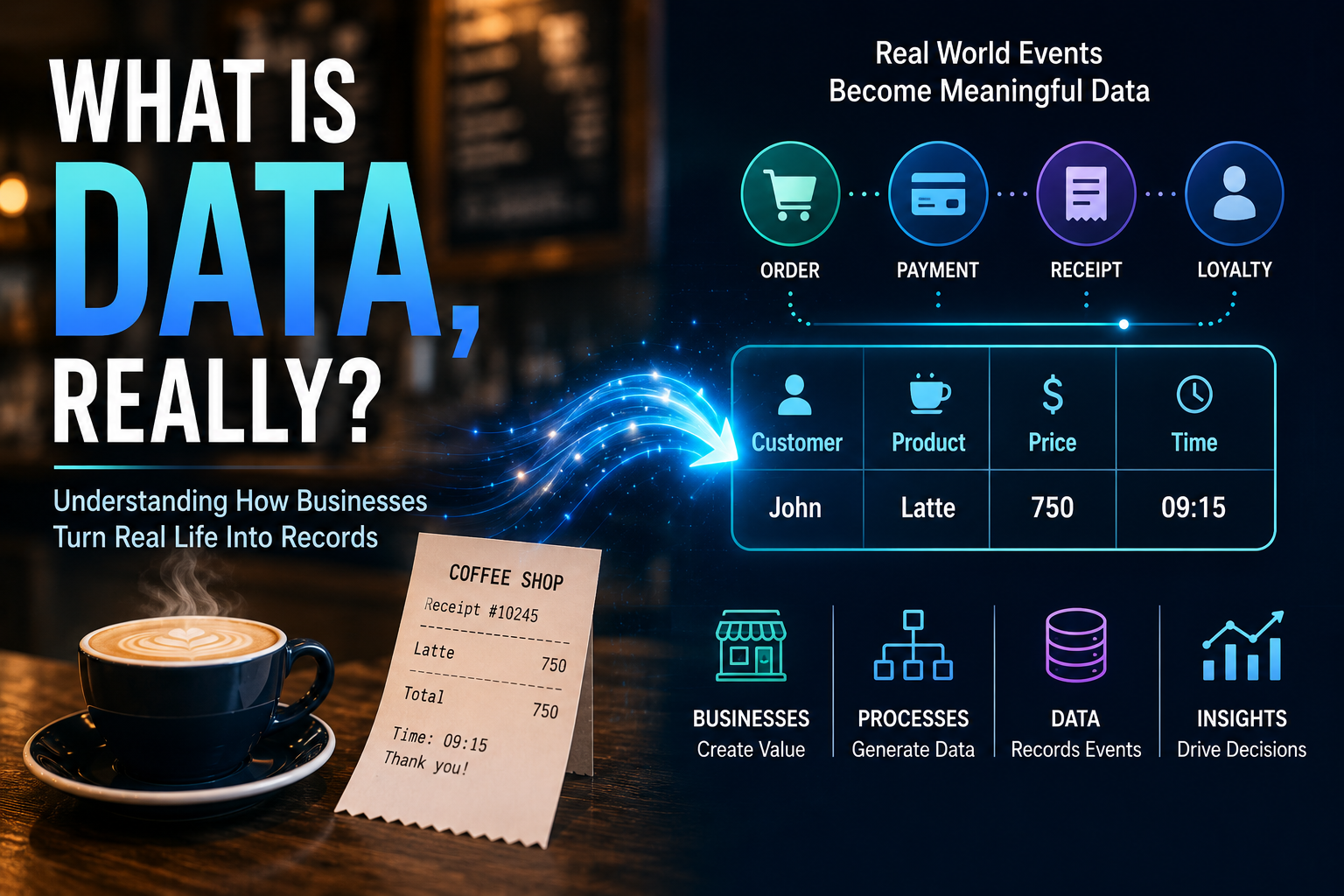
Picture a small business called Sunrise Coffee. Every morning, people walk in, order a cup of coffee, and pay for it. On the surface, it looks simple.
Customers come in, they buy coffee, and money goes into the register. That is the most basic version of a business you can imagine. But running an actual business involves far more moving parts than just collecting cash at the counter, and that is where things get interesting.
What Is a Business, Really?
At its core, a business is an organization that creates value for someone and receives money in return. Notice the wording carefully. The goal of a business is not simply "selling products." The real goal is creating value.
Think about how this plays out in real life. A customer feels tired and wants coffee. The coffee shop makes that coffee. The customer drinks it, feels better, and pays for the experience. That entire chain, from a problem to a solution to a payment, is the heartbeat of every business that has ever existed.
This pattern repeats everywhere once you start looking for it. Uber does not really sell cars or rides in the literal sense, it solves the problem of transportation. Netflix does not sell movies, it sells entertainment and relaxation. A hospital does not sell medicine, it sells healthcare and peace of mind. Every business, no matter how big or small, exists because it solves a problem people are willing to pay to have solved.
Why Do Businesses Exist in the First Place?
Businesses exist because people have problems, and people are willing to pay money to have those problems solved. The bigger and more common the problem, the more people experience it, and the more money a business built around solving it can potentially make.
Here are a few simple examples of how problems turn into businesses:
| Problem | Business |
|---|---|
| Hungry | Restaurant |
| Need transportation | Uber |
| Need groceries | Supermarket |
| Need communication | Telecom company |
| Need accounting help | Accounting firm |
| Need software | SaaS company |
This is a useful mental model to keep in mind. Whenever you are trying to understand what a company does or why it might need a particular product or AI solution, ask yourself what problem it is really solving for its customers.
How Does Money Actually Move Through a Business?
Let us go back to Sunrise Coffee. Imagine that on a single day, one hundred customers walk in, and each one buys a coffee for five hundred rupees. That means the shop earns fifty thousand rupees that day. This money that comes in from selling coffee is called revenue.
Understanding Revenue
Revenue is all the money a business earns from selling its product or service, before subtracting any costs at all. Think of revenue as the money that walks in through the front door. If Sunrise Coffee sold fifty thousand rupees worth of coffee, then its revenue for that day is exactly fifty thousand rupees. Nothing has been taken out yet, no rent, no salaries, nothing. It is simply the total amount of money that came in from customers.
Understanding Expenses
Of course, making coffee is not free. To serve those hundred cups, the shop needs coffee beans, milk, sugar, electricity, and staff to actually make and serve the drinks. On top of that, the shop has to pay rent for its space, keep the internet running, pay for cleaning, and sometimes spend money on advertising to attract more customers.
All of these costs are called expenses. Expenses are simply the price of keeping the business running day to day. Let's look at what that might look like for Sunrise Coffee in a single day.
Revenue: fifty thousand rupees.
Expenses breakdown:
Milk: six thousand rupees.
Coffee beans: eight thousand rupees.
Rent: ten thousand rupees.
Salaries: twelve thousand rupees.
Electricity: two thousand rupees.
Internet: five hundred rupees.
Cleaning: fifteen hundred rupees.
Total expenses come out to forty thousand rupees.
Understanding Profit
Now comes the question that actually matters most to any business owner: after paying for everything, how much money is actually left over? That leftover amount is called profit.
The formula is straightforward. Revenue minus expenses equals profit. In our example, fifty thousand rupees in revenue minus forty thousand rupees in expenses leaves ten thousand rupees in profit. That ten thousand rupees is what the business truly earned that day.
This is one of the most common points of confusion for beginners, so it is worth repeating clearly. Revenue is money coming in. Profit is money left over after everything has been paid. They are not the same thing, and mixing them up can lead to a completely wrong picture of how a business is actually doing.
Here is a comparison that shows why this distinction matters so much.
Company A has revenue of ten million rupees but expenses of nine point eight million rupees. That leaves a profit of only two hundred thousand rupees, a huge amount of revenue but a tiny profit.
Company B has revenue of just one million rupees and expenses of five hundred thousand rupees. That leaves a profit of five hundred thousand rupees. Even though Company B's revenue is much smaller, it is actually the healthier and more efficient business, because it keeps a much larger share of what it earns.
This is exactly why investors, analysts, and smart business owners never judge a company by revenue alone. Profit tells the real story.
Cash Flow: The Hidden Trap That Kills Businesses
This is the part where many businesses actually fail, even ones that look successful on paper. Imagine that today, Sunrise Coffee sells fifty thousand rupees worth of coffee to a corporate client for an office event. That sale counts as revenue. But the corporate client says they will pay in thirty days instead of paying immediately.
So the sale is recorded, the revenue technically increased, but no actual cash has landed in the bank account yet. Meanwhile, today, the coffee shop still has to pay its staff, its rent, its electricity bill, and its milk supplier. All of those payments are due right now, in real cash, regardless of when the client eventually pays.
This is the concept of cash flow. Cash flow is the actual movement of real cash into and out of the business, separate from what has simply been recorded as a sale. A business can show impressive sales numbers, a full million rupees in this example, while having zero rupees of actual cash received and five hundred thousand rupees of bills due today. On paper, the company looks like it's thriving. In reality, it cannot pay its bills.
This is exactly why healthy, growing companies sometimes go bankrupt. They are not unprofitable, they simply run out of actual cash at the wrong moment. This single idea, that sales can rise while cash in the bank falls, is one of the most important lessons in all of business and finance.
Assets: What the Business Actually Owns
Assets are things a business owns that hold real value and help it operate or make money. For Sunrise Coffee, assets might include the coffee machine, the tables and chairs, cash in hand, the money sitting in the bank, the building itself if owned, a delivery bike, unsold inventory like coffee beans, and even a laptop used for managing orders.
The important thing to understand here is that assets are not the same as expenses. When you buy a coffee machine, you are not simply spending money and losing it, you are investing in something that will help produce thousands of cups of coffee over its lifetime, generating revenue again and again. That is the key difference between an expense, which is consumed and gone, and an asset, which continues to provide value over time.
Liabilities: What the Business Owes
Liabilities represent money the business owes to others. Suppose Sunrise Coffee wants to buy a brand new coffee machine that costs eight hundred thousand rupees, but the shop does not have that much cash sitting around. So the owner takes out a loan from the bank to cover the cost.
Now two things exist at once. The coffee machine itself becomes an asset, because it belongs to the business and helps generate revenue. But the loan from the bank becomes a liability, because it is money the business now owes and will need to pay back over time. You own the machine, but you also owe the bank. Both realities exist together, and a healthy business has to manage that balance carefully.
Putting It All Together
Let's zoom out and look at an entire month for Sunrise Coffee to see how all of these pieces connect.
Customers come in and buy coffee, generating revenue of five hundred thousand rupees for the month. From that revenue, the business pays its expenses, including milk, rent, salaries, and electricity. After subtracting all of those expenses, the business is left with one hundred thousand rupees in profit.
Separately, the business has to track its cash, since some of that revenue might have been received immediately while some might not arrive until next month. At the same time, the business owns a set of assets, such as coffee machines, furniture, inventory, and cash on hand. It also carries liabilities, such as a bank loan or unpaid supplier bills.
All of these pieces, revenue, expenses, profit, cash flow, assets, and liabilities, work together to paint the full financial picture of a business. None of them tell the whole story on their own.
Why Can Sales Increase While Cash Actually Decreases?
This deserves one more pass because it is genuinely one of the most important and counterintuitive ideas in business. Imagine that in a single month, Sunrise Coffee sells one million rupees worth of coffee to corporate clients, and those clients agree to pay within sixty days.
Technically, revenue for the month increases significantly. But today, the business still has to buy more coffee beans, pay its employees, cover the rent, and pay the electricity bill. All of that money is leaving the bank account right now, while the customer payments have not arrived yet and will not arrive for another two months.
So in the same period, revenue goes up while cash in the bank goes down. This is exactly why smart businesses track cash flow as its own separate metric, completely apart from revenue and profit. A company can look wildly successful on paper, with growing sales and rising profit, and still run out of actual cash and collapse if it is not managing this gap carefully.
Thinking Like a Business Engineer
If you ever want to build AI systems, software tools, or any kind of technology solution for a business, do not start by thinking about the model, the algorithm, or the code. Start by thinking about the business itself.
Ask questions like these. Where does this company actually make its money? What are its biggest and most painful expenses? Which of its assets generate the most value? What liabilities create the most financial pressure on it? Where exactly is cash getting stuck in the system? And what kind of data could help improve any of these areas?
These are precisely the kinds of questions that lead to AI systems with genuine business impact, things like demand forecasting, inventory optimization, fraud detection, customer churn prediction, and intelligent document processing. Technology that ignores these financial realities tends to be interesting on paper but useless in practice. Technology built around them tends to actually get adopted, because it solves problems the business truly feels.
Try It Yourself
The best way to make this understanding stick is to practice it. Take a piece of paper and draw your own version of the coffee shop model, following this flow. A customer generates revenue. That revenue flows into the business. The business pays its expenses, owns its assets, owes its liabilities, and receives and spends cash. What remains after all of that is profit.
Once you have drawn that out, try replacing the coffee shop with a real company you know well, something like an app based delivery service, a ride hailing company, a telecom provider, an online store, or a local supermarket. Identify what each box in the diagram represents for that specific business.
This simple exercise builds real intuition far more effectively than memorizing definitions ever could. Once you can look at any business and instantly picture where its revenue comes from, where its cash gets stuck, and which of its assets truly drive value, you are no longer just learning finance. You are learning to think like someone who can design real solutions for real businesses.